His ability was recognised and a bursary was organised for him to attend a selective boarding school. It was a difficult transition. Fred was one of only two Aboriginal students at the school, but his parents and grandmother encouraged him to stay, telling him he needed a good education because one day he would be important for Dunghutti people.
When his father became sick, Fred returned home and completed Year 12 at Kempsey High in 1975. He was the only Aboriginal student in his year and one of only 20 Aboriginal students completing Year 12 across all of NSW.
More than 60 years after he first walked into a classroom, education remains at the heart of Uncle Fred’s work.
He has spent decades advocating for better education for Aboriginal children and passing on Dunghutti language, culture and knowledge. He wants children to begin exploring culture from their earliest years and keep building that knowledge throughout school, so they grow up knowing “who they are, where they belong.”
For Uncle Fred, the goal is simple.
“My vision is a happy, healthy, safe child that’s able to reach their potential, whatever that is.”
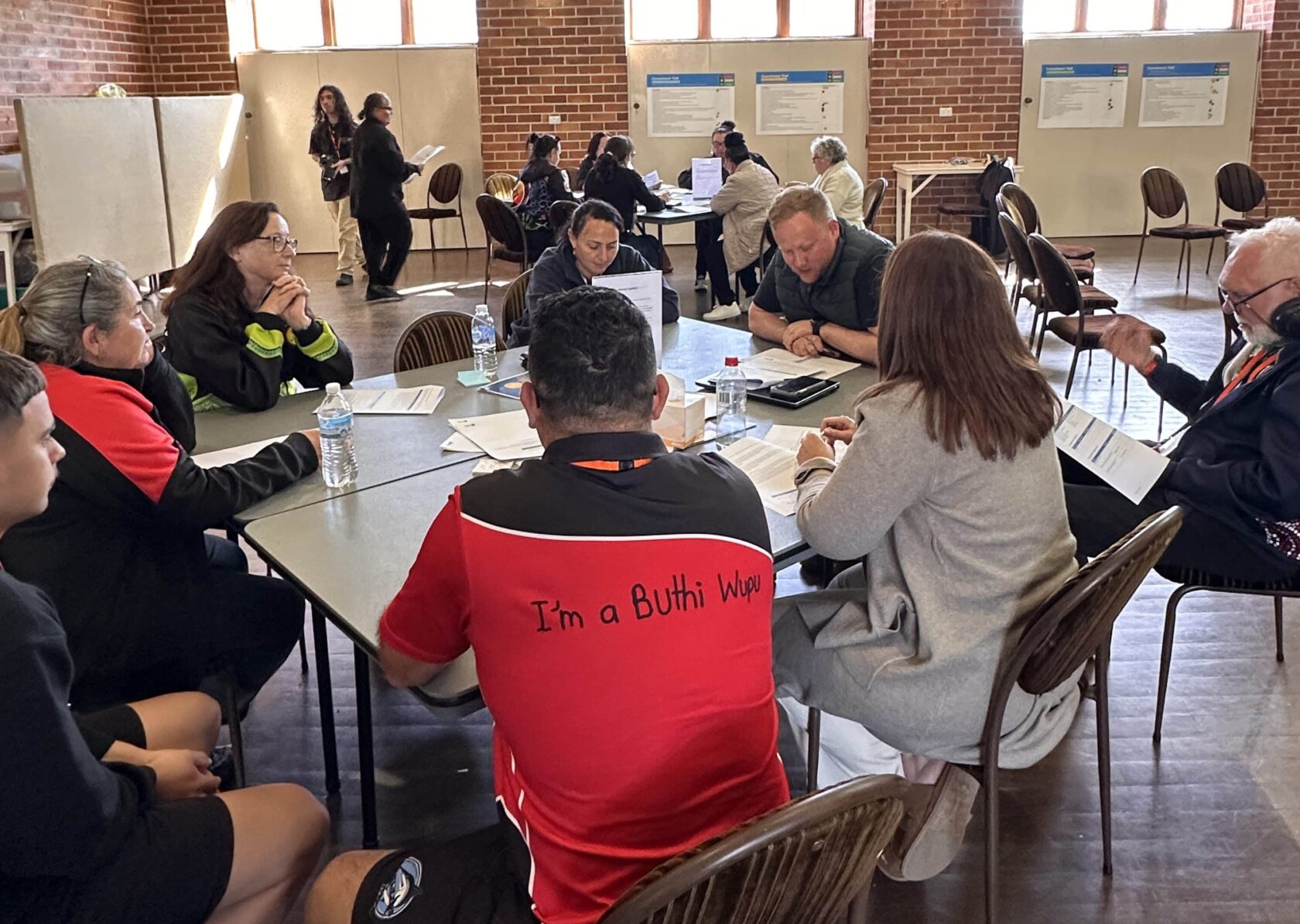
It is a vision shared by many of the people who gathered in Kempsey over two days in September for the latest Learning the Macleay Action Groups.
Around the tables were community members and Elders alongside people working in Aboriginal organisations, schools, early childhood, family services and government. They brought different knowledge and experience, but a common purpose: supporting children, families and communities across the Macleay Valley.
From community priorities to action
The Action Groups grew from conversations with community about what matters in the Macleay and what people want to see happen.
There are four groups, each focused on a different part of life in the Valley.
Starting Strong Together is looking at what children from birth to five and their families need, including strengthening the local early childhood workforce and creating better connections between families and support.
Our Schools, Our Community is working on personalised learning pathways, culturally grounded education and stronger relationships between schools, families and community.
Acceptance and Healing is exploring intergenerational conversations, locally grounded approaches to healing, and cultural learning for people working on Dunghutti Country.
And Coming Together, Restoring Respect is working on community approaches to conflict, family safety and understanding the local justice landscape so support can reach people earlier.
By September, the groups had moved from identifying priorities to shaping practical projects around them.
Taylor Kelly-Scholes from Learning the Macleay is part of the backbone team bringing the groups together and co-chairs the Acceptance and Healing Action Group. She sees the work as a way to create change across the whole community.
“Healing is not only for Aboriginal people, but it’s for the whole community,” Taylor said. “It’s everyone working together and healing together as well.”
The work is also about building the relationships and structures that give people in the Macleay a stronger say in decisions that affect their community, including what support is needed and how resources can be used around locally identified priorities.
Bringing local knowledge together
This way of working recognises something simple: valuable knowledge already exists across the community.
For Anika Malcolm, a Kempsey local and community development worker with the Benevolent Society, the Action Groups are an opportunity to bring more of that knowledge together.
Through Communities for Children, the Benevolent Society supports six local community partners working directly with children and families. Anika co-chairs the Starting Strong Together Action Group, bringing the experience and knowledge built through more than 20 years of the program operating in Kempsey.
She sees real potential in organisations bringing their different perspectives and experience to a shared goal.
For families, that could mean clearer information, smoother pathways between services and stronger connections between the people supporting them.
“Can I see change within this next generation to come? Absolutely, I wholeheartedly believe that we can.”
Local knowledge shaping local solutions
The projects taking shape through the Action Groups show why having local voices involved in decisions matters.
In the Acceptance and Healing Action Group, for example, the group is exploring cultural learning for people who choose to work on Dunghutti Country. Taylor explained that cultural awareness training available to local workers is not always specific to the Macleay. The group plans to develop training grounded in Dunghutti history, culture and protocols.
The group is also exploring intergenerational conversations that create opportunities for Elders and younger people to come together and share knowledge.
Which brings us back to Uncle Fred.
Fred has been learning and carrying Dunghutti language for around 40 years, much of it passed to him through family and other cultural knowledge holders. He remembers listening closely to conversations as a young person and learning the stories that travelled with language.
“We’ve got to give away our language to our young people, and then they keep it.”
The same principle can be seen across the Action Groups: bringing together what families know, what community knows, what services know and what the data says, then using that fuller picture to decide what should happen next.
It is an approach being taken by place-based communities across Australia, creating ways for local people to set shared priorities and have greater influence over the decisions and resources that affect their communities.

Small wins becoming bigger wins
Robert Silva from Learning the Macleay is part of the backbone team doing much of the work behind the scenes to bring the Action Groups together.
He is clear that the work is still growing. There are more people to bring into the room and relationships to build, particularly as the groups move towards practical projects and work out who needs to be involved.
His advice for anyone working in this way is to keep going.
“Stick at it,” Robert said. “You’ll have challenges. You’ll have ongoing issues. You’ll have knockdowns and failures and things along the way. Just keep at it. Keep on going.”
The important thing, he said, is recognising the small wins along the way and knowing that “those smaller wins will become bigger wins one day”.
For Robert one sign of longer-term change would be a Valley where Dunghutti culture is understood and celebrated as part of everyday life. A place where people recognise that “we live here, we work here, we play here, we school here” on Dunghutti Country.
The same big canoe
Towards the end of our conversation, we asked Uncle Fred whether he saw value in bringing people together in this way.
“Only way to work. Only way to do it.”
Then he gave us an image that seemed to capture much of what we had seen over the two days.
“We’re working against a really strong current, and each individual organisation is in their own little canoe, their own little boat, battling the current,” he said.
“Whereas if everyone was in the same big canoe, we’d smash the current.”
The September Action Groups were another step towards getting more people into that canoe.
At the end of our time in the Macleay, we were invited to the Koori Formal at Macleay Vocational Education College, where families, community and local high schools celebrated more than 40 First Nations students graduating Year 12 in 2026 from across the Valley.
The formal began as a small community-run celebration more than 30 years ago. Today it is a whole-of-Valley event, with the graduating cohort growing year on year.
It was a fitting way to end our visit. In 1975, Uncle Fred returned home to finish Year 12 at Kempsey High as the only Aboriginal student in his year. Fifty-one years later, more than 40 First Nations Year 12 graduates gathered in the same Valley to celebrate together.
The Action Groups are building on those generational efforts, bringing community together to take practical steps towards a bright future for all young people and families in the Macleay Valley.